
America gave up its rare earth edge. China took full advantage.
 1 month ago
7
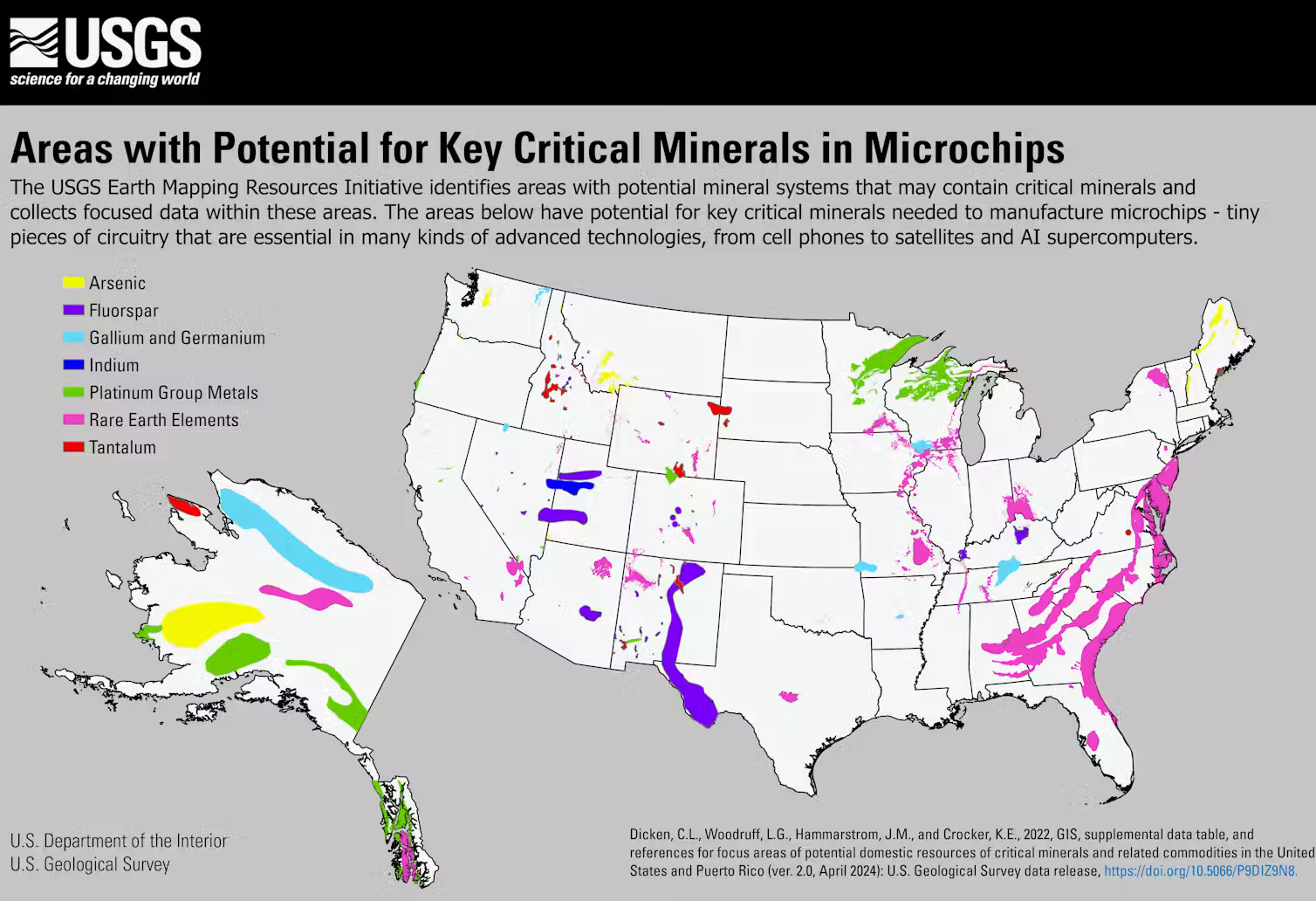
The US has rare earth deposits, but little mining. The pink areas in this US Geological Survey map are believed to have potential for rare earth deposits.
Credit: USGS
The US has rare earth deposits, but little mining. The pink areas in this US Geological Survey map are believed to have potential for rare earth deposits. Credit: USGS
The US government has committed more than $7 billion since April 2025 to try to rebuild US rare earth production capacity. The Pentagon bought $400 million of preferred stock in rare earth producer MP Materials in 2025, giving it 15 percent ownership of the company. MP Materials expects its next magnet plant to begin testing the equipment in 2028.
The Commerce Department also signed a letter of intent in 2026 to give a magnet maker, USA Rare Earth, $277 million in direct funding and a $1.3 billion loan, both aimed at developing facilities in Texas and Oklahoma.
But export roadblocks put up by China are making rebuilding that supply chain more difficult.
What happens on November 10
On Oct. 9, 2025, China’s Ministry of Commerce announced six wide-ranging export control measures. One, Announcement No. 61, affects what even factories abroad can export. A factory in Germany or Japan would need a Chinese license to export a product if Chinese-origin rare earths made up 0.1 percent or more of its value, or if it used Chinese rare earth technology.
After President Donald Trump met Chinese leader Xi Jinping that month, Beijing suspended six export controls until Nov. 10, 2026, in exchange for Washington pausing its “affiliates rule,” which imposes restrictions on companies that are majority-owned by certain blacklisted firms, for one year.
Both controls snap back into place automatically unless both governments extend their pauses.
What stays in place
Some of the export rules were never suspended, including licensing imposed by China in April 2025 on exports of seven of the heavier rare earths.
Automaker Ford saw how the export controls can affect a company when it had to idle its Chicago assembly plant for a week in May 2025 for want of magnets—critical to speakers and electrical motors—because of the export rules. Ford CEO Jim Farley described his supply as “day to day” because he had no alternate source. Ford was able to resume production only with Beijing’s approval.
On June 22, 2026, China’s Ministry of Commerce put 10 US companies on its export control list. Neither Chinese nor foreign firms can sell those companies any goods that have both civilian and military uses. Most of them build drones, radar, aerospace systems, and military vehicles. Two of them—MP Materials and USA Rare Earth—are the federally backed American companies furthest along in building a mine-to-magnet chain.
Beijing said its move was a response to a similar move by the Pentagon. My interpretation is that China picked MP Materials and USA Rare Earth because they are best placed to reduce America’s need for Chinese processing.
An extension of the pause on Nov. 10 would honor the truce, but the heavy rare earth licenses and the June 22 ban on the targeted firms would still apply. The truce means both parties get to play nice. It doesn’t mean they are being nice.
Three paths
For the US, leaving processing in China is the fastest and cheapest solution, but that leaves it exposed to Beijing’s restrictions.
Rebuilding a US rare earths supply chain would remove most US dependence on China for rare earths and the political leverage it implies. But it would take longer, startup costs run to the billions of dollars, and separation produces acidic, and sometimes radioactive, residues.
Building a supply chain with allies such as Australia or Japan, both of which have started to build capacity, would lower the risk of the US being cut off unilaterally. Japan has run this play with some success, but the suspended Chinese rules affect any use of their technology abroad.
President Xi’s Sept. 24, 2026, meeting with Trump may help determine the status of the Nov. 10 restrictions, but the larger conflict over leverage will continue.
Charles Edward Gehrke is a Sloan Fellow at the Massachusetts Institute of Technology (MIT)
This article is republished from The Conversation under a Creative Commons license. Read the original article.

The Conversation is an independent source of news and views, sourced from the academic and research community. Our team of editors work with these experts to share their knowledge with the wider public. Our aim is to allow for better understanding of current affairs and complex issues, and hopefully improve the quality of public discourse on them.





 English (US) ·